Or: How a Conversation With a Very Patient Astronomer in Arizona Accidentally Produced the Infrastructure Project of the Next Millennium
A dispatch from the Department of Ideas That Sound Wrong Until You Do The Math, Which Takes About Four Minutes
There is a specific kind of look that credentialed experts give you when you suggest something they have already categorized, filed, and dismissed before you have finished your second sentence.
It is not contempt, exactly. It is something more refined than contempt. It is the expression of a person who has spent fifteen years acquiring expertise in a subject and is now watching someone who acquired their expertise between the appetizer and the entrée suggest something that the expert's entire educational framework has pre-labeled does not work — and who must now decide, in real time, whether this particular stranger deserves the full explanation or just the short version that ends the conversation politely.
The astronomer at the observatory in Arizona — a real person, a credentialed professional, a person who has spent genuine time thinking about planets and gravity and the mathematics that governs both — gave us the look.
It lasted approximately three seconds.
Then he told us, with the measured patience of a person who has explained the difference between centrifugal and centripetal force to undergraduates for longer than he cares to remember, that we did not understand the difference between centrifugal and centripetal force.
He was not entirely wrong about that.
He was, however, wrong about the invention.
The Invention, Stated Simply For People Who Are Not Astronomers in Arizona
Here is the problem: large planets have crushing gravity. A planet with twice Earth's surface gravity — a perfectly plausible super-Earth of the type astronomers are finding with increasing regularity around nearby stars — would make every human visitor feel like they weigh twice what they do at home. Walking is exhausting. Climbing stairs is a medical event. Dropping something on your foot is genuinely dangerous. The entire tourist experience is spent contemplating how much your skeleton hurts.
This is bad for the tourism industry.
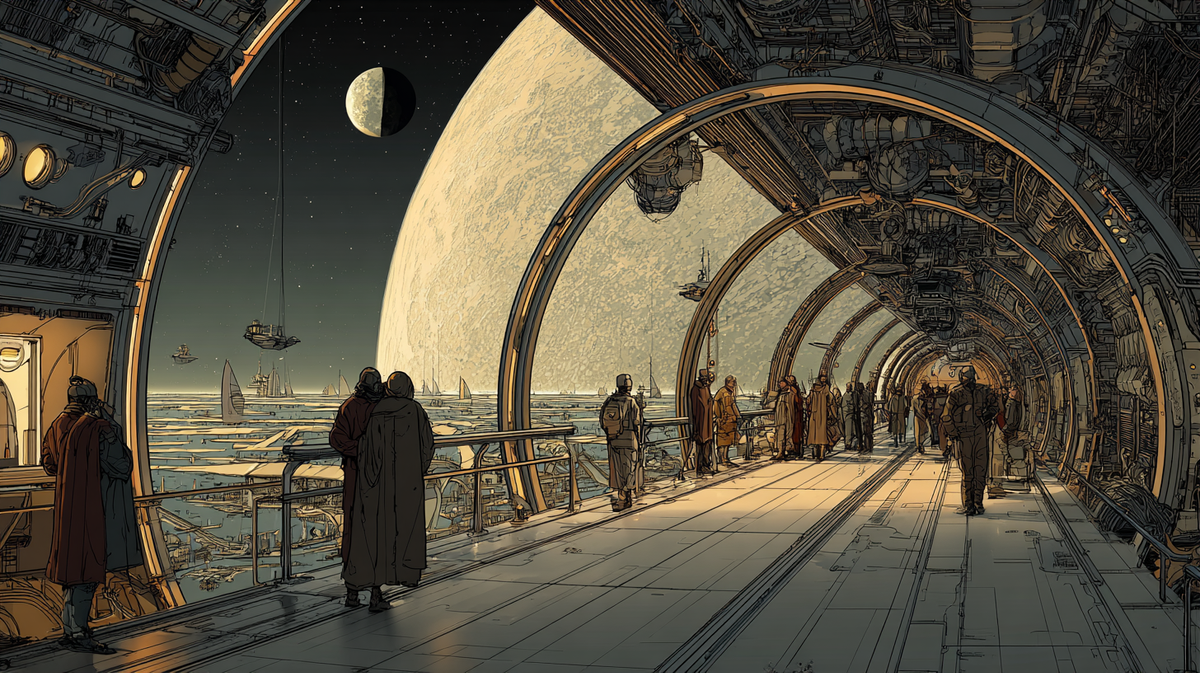
Here is the proposed solution: wrap a moving platform around the planet's equator, sealed inside a transparent tube so that the 800 km/h winds generated by the platform's motion don't immediately kill everyone on it. Move the platform fast enough that the centripetal acceleration it generates — the outward push from traveling in a curve — partially cancels the planet's surface gravity.
Stand on the moving platform. Weigh less.
This is the whole idea. It is, at its core, the same principle as the fact that you weigh very slightly less at Earth's equator than at its poles, because Earth's rotation provides a small centripetal acceleration that subtracts from gravity. We are simply proposing to dramatically increase that effect by moving the platform much faster than the planet rotates.
The astronomer's objection — that we were confusing centrifugal force (the apparent outward push you feel in a rotating frame) with centripetal force (the actual inward force that keeps you moving in a curve) — was technically correct and practically irrelevant. The math works out identically regardless of which frame you prefer to analyze it in. In the rotating frame, centrifugal force pushes you outward, reducing your apparent weight. In the inertial frame, the centripetal acceleration required to keep you moving in a circle reduces the normal force the ground exerts on you.
Same number. Same effect. Different words.
The astronomer knew this. We suspect he objected on principle, the way a classically trained musician might wince when someone describes a chord progression using the wrong terminology even though the music sounds correct.
We hold no grudge. The invention stands.
The Mathematics, Which Are Unimpeachable
We want our tourists to feel Earth-normal gravity — 1g — on a planet with 2g surface gravity. The platform must therefore provide 1g of centripetal acceleration to cancel the excess.
We ran the numbers for a planet with Earth-like density and exactly double Earth's radius — which gives exactly double Earth's surface gravity, neatly and elegantly, in a way that suggests the universe occasionally cooperates with thought experiments.
Such a planet has a surface radius of approximately 12,752 kilometers.
The required platform velocity to generate 1g of centripetal acceleration at that radius:
v = √(g × r) = √(9.81 × 12,752,000) = 11,185 meters per second
That is 40,266 kilometers per hour.
That is Mach 33.
That is faster than the Space Shuttle was traveling when it reentered the atmosphere, during the part where it was on fire.
The platform floor, on which our tourists are standing and taking photographs and arguing about which restaurant to visit for dinner, is moving at Mach 33 inside a sealed transparent tube wrapped around the equator of an alien planet.
This is fine. The tube handles the aerodynamics. The engineering is, admittedly, somewhat challenging. We will address this in the testing section.
A Brief Note on the Astronomer's Other Objection, Which Was About the Engineering
After we clarified the centripetal/centrifugal nomenclature issue to his satisfaction — or rather, after he clarified it to ours — the astronomer raised a second objection, which was essentially: even if the physics is correct, the engineering is so far beyond any conceivable civilization's capability that the idea is not worth discussing.
This is the kind of objection that would have gotten you thrown out of serious conversation if you had raised it in 1850 about heavier-than-air flight, in 1900 about nuclear energy, or in 1950 about landing on the moon.
We note this not to be glib — the astronomer's engineering intuition is completely correct for any civilization that currently exists — but to observe that "currently unbuildable" and "wrong" are different categories of problem, and that conflating them is how experts accidentally dismiss the ideas that their great-great-grandchildren end up building.
The astronomer was talking about now. We are talking about later. Specifically, much later.
The Competitive Landscape
As with all great infrastructure inventions, the question of who gets credit will eventually become more contentious than the question of whether it works.
The United Nations Interplanetary Tourism Authority (established approximately 2340, currently embroiled in its fourth consecutive decade of committee deliberations about the environmental impact assessment framework for the initial feasibility study) will note that the concept was first published in an informal humor article in the early twenty-first century by an inventor who also, in the same period, designed a sleep pod based on rotisserie chicken cooking technology. They will commission a heritage plaque. The plaque will be very tasteful.
The Descendants of Elon Musk — who by this point are technically a separate subspecies of humanity, having spent fourteen generations on Mars at 0.38g, standing an average of 2.3 meters tall, with bone density that makes a sparrow look structurally overbuilt — will claim prior art based on their own version of the platform, which runs in the opposite direction to make Mars's 0.38g feel like a full 1g for the benefit of visiting Earth tourists who keep fainting and requiring medical attention.
Their version is called the GravBoost Martian Surface Experience Platform™, retroactively patented in 2287, and they are extremely litigious about it.
Legal scholars of the period will note that making something heavier and making something lighter are technically different inventions. The Musk descendants will note that their legal team has 200 years of experience in this specific area and would like to discuss it further. Extensively. In arbitration. On Mars, where the venue fees are higher.
The Chinese Interstellar Development Corporation will announce the completion of the first operational planetary treadmill on Kepler-452b in 2401, describing it as a wholly indigenous innovation developed through the principles of self-reliant planetary infrastructure engineering. When a journalist asks about the 21st century humor article, the CIDC spokesperson will note that jokes are not patentable and that the specific implementation draws on seventeen thousand proprietary improvements developed over three centuries of Chinese aerospace research, none of which are subject to prior art claims from Earth-based comedy writing.
They will not be entirely wrong about this.
The European Planetary Infrastructure Consortium will have the most elegant system, operating at precisely 1.000g as measured by instruments of extraordinary precision, powered entirely by renewable energy sources, with a carbon offset program for the construction emissions that took 40 years to negotiate and is considered a landmark achievement of interplanetary climate diplomacy. It runs through scenery of heartbreaking beauty. The queue to board is currently 11 years long.
JAXA's version will have been operational for 30 years by the time anyone else finishes their environmental review.
How We Test This on Earth
Every credible invention requires an experimental validation program. Here is ours, proceeding from the practical to the ambitious.
Test 1: The Merry-Go-Round Confirmation
This test is already complete. Every child who has ever stood on a merry-go-round and felt themselves pulled outward has confirmed the fundamental physics of this invention. We are claiming this as a successful proof of concept and moving on.
Test 2: The High-Speed Train Platform
A person standing on a train traveling at 300 km/h around a curve of known radius experiences measurable reduction in apparent weight due to centripetal acceleration. The effect at these speeds and radii is small — fractions of a percent — but it is real, it is measurable with sufficiently sensitive instruments, and it is precisely the physics we are proposing to scale up by a factor of approximately ten thousand.
We propose that someone do this measurement carefully and publish it. We will read the paper with great interest from the comfort of our chair.
Test 3: The Maglev Track in the Nevada Desert
A circular maglev track of radius 10 kilometers, capable of accelerating a test sled to 1,000 km/h, would generate approximately 0.08% reduction in apparent weight for objects on the sled. This is detectable. It is not impressive. But it is a data point, and data points are how you build a case.
We estimate this would cost somewhere between $2 billion and $4 billion to construct. We are currently looking into grants.
Test 4: The Retired Space Shuttle Main Engine Strapped to a Very Long Rail
We prefer not to discuss the details of this test in a public document. Suffice to say it involves hypersonic velocities, a circular track of several hundred kilometers radius, and a test mass that is definitely not a person, legally speaking. The weight reduction achieved would be approximately 2-3% of Earth gravity, which is not enough to matter therapeutically but is absolutely enough to publish a paper about.
The paper would be titled: Measurable Reduction in Apparent Weight of a Test Mass Traveling at Hypersonic Velocity on a Curved Track: Implications for Planetary Tourism Infrastructure on Super-Earth Exoplanets.
It would be the best paper ever published. The peer reviewers would either immediately accept it or immediately resign. There is no middle outcome.
Test 5: Just Go To Space
The limiting case of our platform — maximum velocity, minimum apparent weight — is orbital velocity, at which point weight becomes zero entirely. This is called being in orbit, and humans have been doing it since 1961. Every astronaut who has ever floated weightlessly in a spacecraft has, without knowing it, been a test subject for the extreme end of our weight-reduction curve.
We are claiming all of them as experimental validation.
The astronomer in Arizona will object to this characterization. We look forward to the conversation.
The Honest Physics Footnote
There are two things worth saying clearly, in the spirit of intellectual honesty that has characterized this publication's coverage of civilization-scale infrastructure proposals.
First: the platform velocity required is not a minor engineering challenge. Moving a physical structure the circumference of a planet at Mach 33, maintaining structural integrity, and keeping tourists alive on it is a problem that would require materials and energy systems that do not currently exist. The tube that encloses it must withstand the pressure differential of essentially supersonic flow, thermal loads, and the occasional micrometeorite, for the entire circumference of a planet, indefinitely. No existing material handles this. No existing power source provides the energy to accelerate it. The engineering gap between here and there is roughly equivalent to the gap between a campfire and a fusion reactor.
Second: none of this makes the physics wrong. The centripetal subtraction from effective weight is real, it is calculable, and it scales exactly as the math says it does. When a civilization exists that can build it — and such a civilization will eventually exist, somewhere, if our species or its descendants last long enough — the blueprint is the same equation it was when we first scribbled it on a napkin while an astronomer in Arizona looked at us with patient, affectionate, not entirely warranted condescension.
The idea works.
The civilization isn't ready yet.
That is a problem with the civilization, not the idea.
In Conclusion
The astronomer in Arizona is a smart person doing important work and we bear him no ill will whatsoever.
He was right about the terminology.
He was right about the engineering.
He was right that no civilization currently alive could build this.
And he was wrong — in the way that careful, credentialed experts are sometimes exquisitely, fascinatingly wrong — about whether the idea was worth discussing.
Every civilization-scale infrastructure project that has ever been built was, at some earlier point in history, not worth discussing. The people who built them anyway, or who wrote them down so that someone else could build them later, were not smarter than the experts who dismissed them.
They were just less impressed by current limitations.
Our platform will girdle a planet someday. Tourists will stand on it and complain that their feet hurt and the view isn't as good as the brochure suggested and the restaurant prices are outrageous.
They will weigh exactly 1g while doing so.
We will consider that a success.
The Planetary Treadmill concept is hereby released into the public domain, on the grounds that if you can build it, you deserve it. The astronomer in Arizona is welcome to co-author any resulting papers. The Musk descendants are advised that the prior art documentation is timestamped. All weight measurements approximate; consult your physician before traveling to super-Earth exoplanets.
Jonathan Brown (A.A.Sc., B.Sc) writes about cybersecurity infrastructure, privacy systems, the politics of AI development and many other topics at bordercybergroup.com and aetheriumarcana.org. Occasionally he feels the need to take a day off from taking life seriously... Border Cyber Group maintains a cybersecurity resource portal at borderelliptic.com . He works from a custom-built Linux platform (SableLinux™) which is currently under development and fully documented at https://github.com/black-vajra/sablelinux.
If you would like to support our work, providing useful, well researched and detailed evaluations of current cybersecurity topics at no cost, feel free to buy us a coffee! https://bordercybergroup.com/#/portal/support
Member discussion: