Border Cyber Group | June 7, 2026
There is a clock running above your head right now. It is not metaphorical. It is a rigorously derived mathematical metric, maintained by researchers at Princeton University and the University of British Columbia, and it currently reads 2.5 days. The metric is called the CRASH Clock — Collision Realization and Significant Harm — and what it measures is this: if every satellite in low Earth orbit lost its ability to conduct collision avoidance maneuvers simultaneously, how long before the first catastrophic impact? The answer, as of May 4, 2026, is two and a half days.
In 2018, that number was 164 days.
The compression of that figure — from five months to less than three days in under a decade — is the story of what humanity has done to low Earth orbit since the advent of satellite mega-constellations. The solar maximum now underway is not the cause of this problem. But it is the trigger condition most likely to make it acute. Understanding why requires working through three distinct but interlocking systems: solar physics, orbital mechanics, and the governance infrastructure — or its absence — that is supposed to hold it together.
The Sun Right Now
Solar Cycle 25, the current eleven-year cycle of solar activity, peaked in late 2025 and its maximum phase is expected to extend through 2026. The National Oceanic and Atmospheric Administration's Space Weather Prediction Center and NASA have both confirmed this is an active cycle — more active than pre-cycle forecasts anticipated. The signature events are familiar: increased sunspot counts, elevated X-ray and ultraviolet emissions, solar flares across the spectrum, and the phenomenon most consequential for orbital infrastructure, coronal mass ejections.
A coronal mass ejection is a large expulsion of magnetized plasma from the solar corona. When directed toward Earth, a CME takes one to three days to arrive, compresses the magnetosphere on approach, and triggers a geomagnetic storm whose intensity is measured on NOAA's G1-through-G5 scale. In November 2025, the British Geological Survey upgraded its forecast to the maximum G5 intensity level in response to a "cannibal storm" — a second CME that overtook and merged with the first — describing it as potentially the largest solar storm to strike Earth in over two decades. The storm disrupted GPS accuracy and prompted immediate responses from satellite operators across the constellation fleet.
The physical mechanism by which geomagnetic storms threaten orbital infrastructure is specific and worth understanding precisely. When a CME interacts with Earth's magnetosphere, it deposits enormous amounts of energy into the upper atmosphere. That energy heats the thermosphere — the atmospheric layer between roughly 80 and 600 kilometers altitude, the same layer where most operational satellites orbit — and causes it to expand outward. The expansion is substantial. During the May 2024 G5 storm, NASA researchers documented a thermospheric density increase of nearly 50 percent in the hours following impact. That increased density means increased aerodynamic drag on every object in low Earth orbit.
The consequences of that drag are not subtle. Satellites traveling at approximately 7.8 kilometers per second lose altitude faster than their onboard thrust systems may be able to compensate. Their orbital trajectories diverge from predicted paths. The Two-Line Element sets — the standardized orbital data that every operator uses to track objects and predict conjunctions — become unreliable. During major geomagnetic storms, positional uncertainties for tracked satellites have expanded to several kilometers. Given that satellites are traveling at 7 kilometers per second, a positional error of that magnitude renders collision prediction effectively impossible for the duration of the disturbance.
This is the mechanism by which the solar maximum becomes an orbital crisis trigger. It does not destroy satellites directly. It blinds the system.
What Has Been Built in the Blind Spot
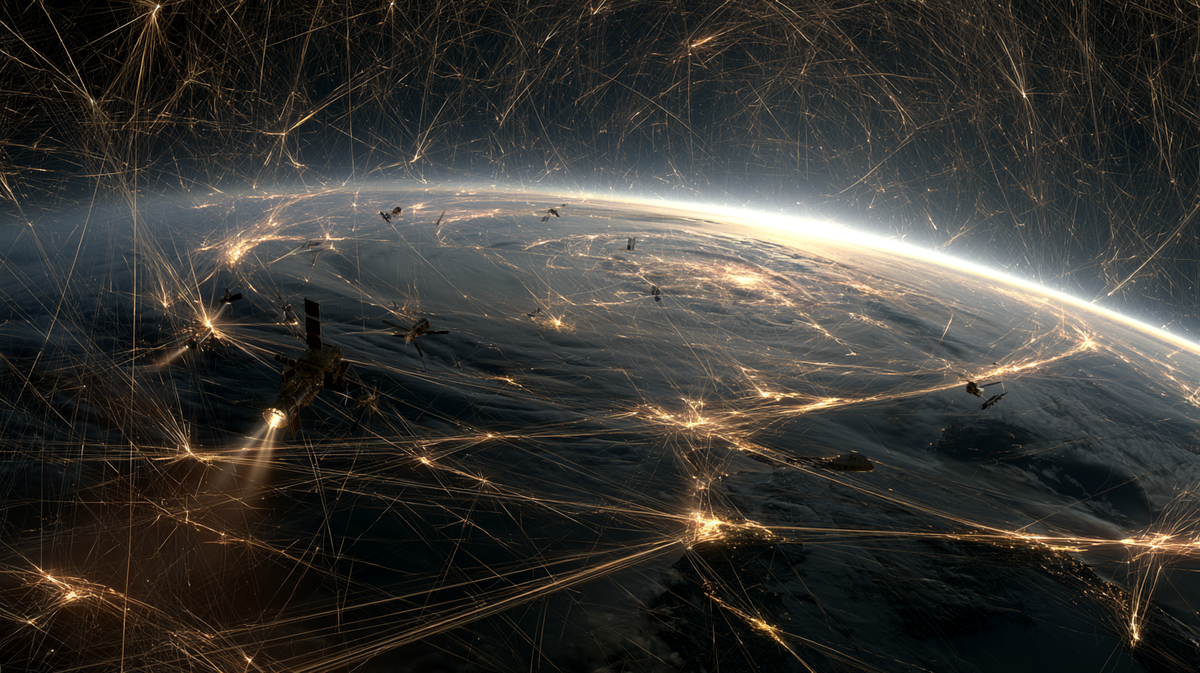
The scale of what now occupies low Earth orbit is difficult to convey in abstract terms. As of 2026, there are approximately 12,000 active satellites in Earth orbit, the majority of them concentrated in LEO. SpaceX's Starlink constellation alone accounts for nearly 7,000 of those — nearly half of all active satellites on the planet, operated by a single private company. Amazon's Project Kuiper is in active deployment. OneWeb, now merged with Eutelsat, maintains its own constellation. China's Guowang project is scaling. The combined planned capacity of announced mega-constellations, if fully realized, would put roughly 100,000 objects in the low Earth orbit band.
The traffic implications of this density are not theoretical. They are operational, daily, and escalating.
In the six months between December 2024 and May 2025, Starlink satellites conducted 144,404 collision avoidance maneuvers. That figure, submitted in a regulatory filing to the FCC, averages to 41 maneuvers per satellite per year — or one collision avoidance maneuver across the Starlink network every 1.8 minutes, around the clock, every day of the year. The number is not a record of near-misses. It is the routine operational tempo of managing a mega-constellation in an increasingly crowded orbital environment. For context: in the six months ending November 2022, the same constellation conducted 13,612 such maneuvers. The rate has increased roughly eleven-fold in three years.
Research published in late 2025 analyzing conjunction data found that across all LEO mega-constellations, a close approach — defined as two catalogued objects passing within one kilometer of each other — occurs every 22 seconds. For the Starlink constellation specifically, one such event occurs every 11 minutes.
The CRASH Clock research team, led by Sarah Thiele, now at Princeton, modeled what happens to this system if the ability to conduct avoidance maneuvers is interrupted. The results have been updated regularly since the paper first appeared in December 2025. The trajectory is direct:
- January 2018: 164 days
- January 2022: 26 days
- January 2024: 6.8 days
- January 2026: 3.8 days
- May 4, 2026: 2.5 days
Each data point represents the expected time to the first catastrophic collision between catalogued objects if maneuvers were to cease. The probability of a major collision occurring within the first 24 hours of a no-maneuver scenario is now 30 percent. That is not a low-probability tail risk. It is the expected behavior of the system under disruption.
What would disruption look like? According to Thiele and her colleagues, the most plausible trigger is a major solar storm. "At the beginning of a solar storm, there's a huge increase in atmospheric density and things start to get pulled down," Thiele told Space.com. "Before things start getting back to normal, you have uncertainties of several kilometers in the positions of satellites, and it becomes impossible to estimate where objects are going to be in the future — and therefore it becomes impossible to predict collisions and conduct avoidance maneuvers."
The November 2025 G5 storm provided a live demonstration of the system operating under pressure. According to reporting from Data Center Dynamics, that single event prompted approximately 5,000 simultaneous satellite maneuvers, the overwhelming majority from Starlink. The carefully maintained spacing between thousands of LEO objects had to be rapidly rechoreographed in response to drag-induced position shifts across the constellation. The maneuvers succeeded. The system held. What the event also demonstrated, without anyone saying it plainly, is that the margin between routine operational stress and unrecoverable cascading failure is measured in hours.
The Debris That Does Not Decay
The solar maximum introduces a complicating dynamic that cuts in two directions simultaneously. The same atmospheric expansion that endangers satellites by increasing drag also accelerates the natural deorbit of debris. During solar maximum conditions, defunct satellites and spent rocket stages at low altitudes reenter the atmosphere faster than they would during solar minimum. This is, in principle, a benefit — it means the orbital environment is partially self-cleaning during active solar periods.
SpaceX has made a major architectural decision based on precisely this logic. In a January 1, 2026 announcement, Michael Nicolls, Starlink's vice president of engineering, confirmed plans to lower approximately 4,400 satellites — nearly half the active Starlink fleet — from their current operational altitude of 550 kilometers to 480 kilometers over the course of 2026. The stated rationale is debris safety: at 480 kilometers, a defunct satellite will naturally reenter the atmosphere dramatically faster than it would from 550 kilometers, particularly during solar minimum when drag decreases and ballistic decay times extend. The planned reduction in ballistic decay time exceeds 80 percent.
The move is being coordinated with USSPACECOM, regulators, and other orbital operators. It is a responsible piece of forward planning by the largest single operator in LEO. It is also a massive simultaneous reconfiguration of nearly half the world's internet-relay satellite infrastructure, conducted during a solar maximum, in an orbital environment where positional uncertainties spike during geomagnetic storms.
The debris picture at higher altitudes tells a less reassuring story. The ESA Space Environment Report for 2025 concluded that even if all new satellite launches were halted immediately, the number of objects in orbit would continue to increase for over 200 years. The debris generation rate — from microparticle collisions, fragmentation events, and degradation — now exceeds the rate at which atmospheric drag removes objects from the relevant orbital bands. The 800-to-1,000-kilometer altitude band, above most active mega-constellation shells but still firmly within LEO, has the highest debris concentrations.
This is not an abstract projection. Russia's November 2021 anti-satellite test of the Cosmos 1408 satellite generated a debris field whose effects are still propagating through the collision avoidance records years later. Research analyzing Starlink operational data found that a single conjunction with a Cosmos 1408 debris fragment triggered a cascade of 27 additional internal Starlink-to-Starlink avoidance maneuvers. The debris from one deliberate act continues to cost the entire constellation operational fuel and maneuver cycles, years after the event, with no end date.
The natural experiment provided by Russia's nascent Starlink competitor arrived with appropriate timing. Object 4 of the Rassvet constellation — the first satellite of Russia's attempted domestic broadband network, launched in March 2026 — reentered the atmosphere on approximately June 6, 2026, less than three months after launch. It never performed a single orbit-raising maneuver. The expanded, solar-maximum-heated thermosphere dragged it down before operators could act. It is a contained incident and a clean demonstration: during this solar maximum, low-altitude objects without functional propulsion do not stay up.
The Governance Vacuum
The technical picture is alarming but tractable. The governance picture is not.
Managing the orbital environment at current and projected constellation densities requires two things: reliable real-time knowledge of where every tracked object is, and a coordination infrastructure that allows operators across national boundaries to share that data and synchronize their responses. The United States built the world's foundational space object catalogue through the Department of Defense, which maintains Space-Track.org and has provided access to its data to civil and commercial operators. The DOD catalogue is the bedrock of global space situational awareness.
The problem with relying on DOD for civil space traffic management is structural. Military space surveillance exists to support national security objectives. As the commercial orbital population has grown to dominate the LEO environment, routing civil traffic coordination through a military system creates conflicts of interest, classification barriers, and mission distortions. The DOD's own interest is in applying its surveillance capabilities to potential adversary threats — not in managing conjunction warnings for Starlink and Kuiper.
To address this, the first Trump administration created Space Policy Directive 3 in 2018, which tasked the Department of Commerce with building a civilian counterpart: the Traffic Coordination System for Space, TraCSS. The logic was sound and the need was clear. When Trump signed that directive, fewer than 5,000 satellites orbited the planet. There are now more than 12,000.
The second Trump administration has proposed eliminating TraCSS entirely.
The fiscal year 2026 budget request cut the Office of Space Commerce from $65 million to $10 million and zeroed out TraCSS funding. The administration's stated rationale — that the private sector can provide equivalent services — understates the problem in a way that is either naive or deliberately evasive. Private space traffic management companies operate commercially, which means they serve paying customers with contractual obligations to their own clients. They do not have authority to compel information sharing across national operators. They cannot coordinate government-to-government responses to crisis scenarios. And they cannot fill the role of a neutral international clearinghouse for conjunction data during a rapidly evolving solar storm that is simultaneously disrupting thousands of satellites across dozens of operators.
Congressional appropriators have pushed back. The Senate Appropriations Committee voted in 2025 to restore the Office of Space Commerce to $60 million in its version of the FY2026 spending bill. Seven industry associations representing over 450 space, satellite, and defense companies wrote a joint letter to Congress urging sustained funding. The FY2027 White House request came in at $11 million — a $1 million increase that the industry immediately interpreted as the same defunding strategy with a fig leaf attached.
As of this writing, TraCSS has not reached full operational capability. Its program manager was among the NOAA employees laid off in the February 2025 DOGE purge and subsequently reinstated, but the institutional damage and operational delay are real. Europe and China both offer free, comprehensive government satellite tracking services. The United States, in the middle of the most dangerous period in the history of orbital crowding, is in the process of dismantling its civilian coordination infrastructure and leaving the gap to market forces.
What Failure Looks Like
The Kessler Syndrome — named for NASA scientist Donald Kessler, who described it in 1978 — is the scenario in which a debris-generating collision produces enough fragments to trigger secondary collisions, which produce more fragments, in a self-sustaining cascade that renders LEO unusable. It is the scenario most frequently cited when discussing orbital overcrowding, and it is frequently dismissed as a remote, slow-moving, decades-long process.
That framing is technically accurate and operationally misleading. Kessler Syndrome unfolds over decades. The crisis that precedes it unfolds in days.
The CRASH Clock measures the immediate trigger window: the period between the onset of a major disruption and the first catastrophic collision that begins the cascade. That window is now 2.5 days. The cascade itself — the Kessler process — would take decades to fully develop. But the first collision, the one that launches the chain, could occur within the week following any event that disables the collision avoidance systems across a significant fraction of LEO operators.
What events could do that? The CRASH Clock research identifies three categories: a major solar storm that simultaneously disrupts telemetry and navigation across the constellation fleet; a coordinated cyberattack against satellite command infrastructure; and a large-scale technical failure. Of the three, the solar storm scenario is unique in that it operates at planetary scale simultaneously, cannot be isolated, and is happening right now in its most active phase.
The downstream consequences of a Kessler-initiating event extend well beyond the loss of satellite internet access. GPS is a satellite constellation. The positioning signals that underpin global shipping, aviation routing, financial transaction timestamping, military coordination, and precision agriculture all run through satellites in MEO and LEO bands. The weather satellite network that feeds every forecast model runs through LEO. The communications relays that provide connectivity to conflict zones, humanitarian operations, and remote infrastructure run through LEO. A debris cascade sufficient to deny access to these bands does not simply inconvenience users of Starlink. It removes the navigational and communications substrate from a civilization that has been quietly building its critical functions on top of it for thirty years.
The Reckoning
The solar maximum is not an unexpected event. It occurs every eleven years on a schedule astronomers have documented since 1843. The current cycle was anticipated. Its intensity, somewhat higher than initial forecasts, was within the range that historical precedent established as possible. The infrastructure stress it is now producing is not the result of an unknowable natural catastrophe. It is the result of building an orbital architecture at a density and pace that the available governance frameworks never caught up to, and then defunding the governance frameworks that existed.
SpaceX conducted 144,404 collision avoidance maneuvers in a six-month period while the U.S. government was proposing to eliminate the civilian coordination system designed to support exactly that operational environment. The company making more avoidance maneuvers than any other entity in human history is the company whose founder sits in the administration that zeroed out the budget for the system meant to help manage those maneuvers.
The conflict of interest is not subtle. It does not require imputing malice to be alarming. What it requires is an honest accounting of what happens when the world's dominant orbital operator has both the technical capability to influence traffic management norms and the institutional proximity to the government body responsible for setting those norms — while the independent civilian coordination infrastructure is being defunded.
The CRASH Clock is a useful instrument precisely because it reduces a complex system to a single, honest number. That number has gone from 164 days to 2.5 days in less than a decade. The solar maximum did not cause that compression. But the next G5 storm — and there will be one — will test it.
The question is whether the systems built to manage that test will still be funded when it arrives.
Border Cyber Group covers cybersecurity, infrastructure security, and geopolitical technology risk. This piece represents initial analysis; a follow-on examination of the governance and regulatory dimensions of orbital traffic management is in preparation.
If you would like to support our work, buy us a coffee!: https://bordercybergroup.com/#/portal/support
Member discussion: