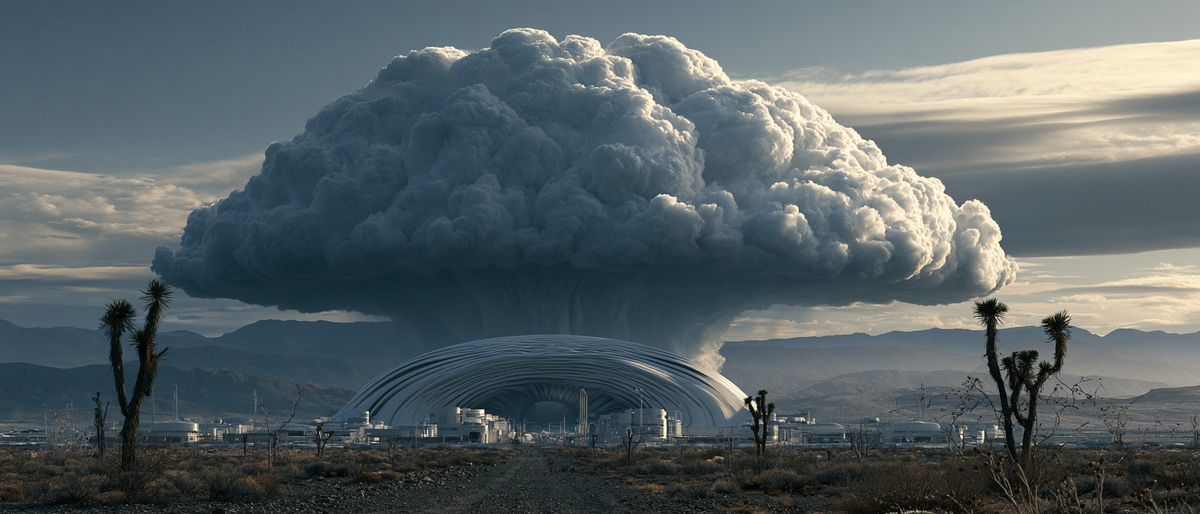
AI, Data Centers, and the New Geography of Computation
The End of the “Cloud” Illusion
For most of the history of the internet, the physical reality of computation remained largely invisible to the people who depended on it. The dominant metaphor of the digital age encouraged this invisibility. Data lived “in the cloud.” Messages traveled through an abstract network imagined less as infrastructure than as atmosphere. Photographs, documents, financial records, entertainment libraries, social relationships, and increasingly entire professional lives appeared to float free from geography and material constraint. The modern user touched a screen, typed a request, and received an answer almost instantaneously. Whatever machinery made such exchanges possible existed somewhere beyond ordinary perception.
That abstraction is beginning to collapse.
Across the United States, vast industrial facilities are emerging from deserts, farmland, suburban peripheries, and electrical corridors at a pace that has startled even utility planners and state regulators. Many are windowless concrete structures hundreds of thousands of square feet in size. Others resemble fortified logistics depots ringed with fencing, substations, cooling towers, and backup power systems. Inside them are not office workers or manufacturing lines, but row after row of servers performing the continuous labor of the digital economy: storing data, routing internet traffic, processing transactions, training artificial intelligence models, and responding to billions of user requests every day.
The modern economy increasingly depends upon these structures, yet most people rarely think about them at all. The convenience of digital life obscures the scale of the machinery required to sustain it. A streamed film, a cloud backup, an AI-generated paragraph, a facial-recognition query, a navigation request, or a conversation with a large language model appears almost frictionless from the perspective of the user. Behind that apparent frictionlessness, however, lies an expanding physical system of extraordinary complexity and appetite.
The rise of artificial intelligence has accelerated this transition from invisible infrastructure to visible industrial presence. Earlier generations of cloud computing already required enormous server capacity, but the computational intensity of modern AI systems operates at an entirely different scale. Training advanced models requires immense concentrations of specialized processors, dense electrical supply, sophisticated cooling systems, and continuous redundancy protections against interruption. As a result, the infrastructure of computation is no longer receding quietly into the background of modern life. It is reshaping landscapes, utility forecasts, zoning battles, water policy debates, and long-term energy planning.
In Northern Virginia, data centers now dominate entire stretches of suburbia once intended for residential expansion. In Arizona, massive server campuses rise amid worsening drought conditions and mounting competition over water resources. In parts of the Midwest and Mountain West, utilities are revising decades-long forecasts upward in response to sudden surges in projected electrical demand driven largely by hyperscale computing facilities. Some regions now treat data centers as strategic economic infrastructure worthy of tax incentives, preferential utility arrangements, and expedited permitting. Others increasingly regard them as disruptive industrial neighbors whose costs are not fully understood.
The scale of the transformation is difficult to visualize because the public vocabulary surrounding digital technology still lags behind its material reality. The language of “the cloud” belongs to an earlier era of the internet, one in which the underlying infrastructure could remain psychologically distant from everyday experience. Artificial intelligence is changing that relationship. Computation now demands territory. It demands power-generation capacity, transmission lines, cooling water, backup generation, fiber corridors, and large tracts of politically obtainable land. The digital economy has not transcended physical infrastructure. Rather, it has become one of the most infrastructure-intensive systems modern societies have ever built.
This transformation carries implications extending well beyond the technology sector itself. The rapid expansion of data centers is beginning to influence decisions about electrical grids, fossil-fuel retirement schedules, municipal tax policy, groundwater allocation, and industrial land use. It is also creating new forms of political tension between local communities, utility providers, environmental planners, and technology firms competing to dominate the emerging AI economy. What appears, from the perspective of the user, to be a purely informational revolution increasingly reveals itself as an industrial one.
The irony is difficult to miss. At the precise historical moment when digital technology appeared to dissolve geography, material limits, and physical presence into streams of pure information, the infrastructure necessary to sustain that illusion became larger, louder, hotter, and more territorially concentrated than ever before. The cloud, it turns out, was never weightless. It was merely hidden.
What a Data Center Actually Is
If the cloud was never truly immaterial, then what exactly is a modern data center?
From a distance, most appear strangely anonymous. They are often windowless structures surrounded by security fencing, electrical infrastructure, cooling equipment, and carefully controlled access roads. Some resemble warehouses. Others look more like utility installations or logistics depots. They rarely advertise themselves openly, and many are designed with an almost deliberate architectural blandness, as though invisibility itself remains part of their function. Yet behind these unremarkable exteriors are some of the most energy-intensive civilian facilities ever constructed.
At the most basic level, a data center is a building designed to house computer servers and the infrastructure necessary to keep those servers operating continuously. But that deceptively simple description obscures the extraordinary complexity of the modern hyperscale facility. What earlier generations might have called a “server room” has evolved into an industrial system measured not merely in square footage, but in megawatts.
The earliest internet infrastructure was comparatively modest. Universities, corporations, and government agencies maintained localized server clusters supporting email systems, databases, and internal networks. As internet traffic expanded during the late 1990s and early 2000s, companies increasingly consolidated these functions into larger centralized facilities. The rise of cloud computing accelerated the process further. Rather than running software locally, businesses and consumers began renting remote computational capacity from firms capable of operating infrastructure at enormous scale.
This transition produced the modern hyperscale data center: facilities engineered to support hundreds of thousands of servers simultaneously while minimizing latency, maximizing redundancy, and controlling operating costs with extraordinary precision. Companies such as Amazon, Microsoft, Google, and Meta no longer merely operated websites or software platforms. Increasingly, they became infrastructure providers whose business models depended upon continuous access to vast computational capacity.
Artificial intelligence has intensified these pressures dramatically.
Traditional cloud computing already consumed enormous amounts of electricity, but many AI systems require substantially denser computational arrangements centered around graphics processing units, or GPUs. Originally designed for rendering complex visual environments, GPUs proved exceptionally effective at handling the parallelized mathematical operations required for machine learning and neural-network training. The consequence is that modern AI facilities can consume far more power per rack than earlier generations of data centers. In some facilities, AI-oriented server cabinets may demand ten or twenty times the electrical density of conventional enterprise workloads.
That escalation changes the physical architecture of computation itself.
A modern hyperscale AI facility is not simply a room filled with computers. It is an integrated energy-management and thermal-regulation system whose primary challenge is converting electricity into computation while preventing the resulting heat from destroying the hardware performing it. Every calculation produces heat. At the scale of millions of simultaneous operations across thousands of processors, heat becomes one of the defining engineering problems of the entire industry.
Inside a large facility, rows of server racks are arranged in carefully controlled corridors designed to separate hot air from cooled intake air. Massive ventilation systems continuously circulate and redirect airflow through the building. Chilled-water systems absorb thermal energy and transport it away from the computing equipment. In some regions, cooling towers release excess heat into the atmosphere through evaporative processes requiring substantial water consumption. In others, operators rely more heavily on electricity-intensive mechanical cooling systems. Every design represents a tradeoff among energy use, water availability, climate conditions, reliability requirements, and operational cost.
Behind the server halls themselves sits another layer of infrastructure rarely visible to the public. Large transformer yards step down incoming high-voltage electricity from transmission lines feeding the campus. Battery systems provide immediate backup power during outages or voltage instability. Arrays of diesel generators stand ready in case the electrical grid fails entirely. Redundancy governs virtually every aspect of the facility because even brief interruptions can produce cascading financial and operational consequences for the companies depending upon them.
This obsession with uninterrupted operation helps explain why modern data centers increasingly resemble critical infrastructure rather than ordinary commercial real estate. Many facilities are designed to maintain continuous operation despite storms, equipment failures, grid instability, or cyberattacks. Security protocols are correspondingly intense. Access controls, surveillance systems, hardened perimeters, and compartmentalized internal architecture are standard features across much of the industry.
Yet despite their scale, data centers often employ relatively few people once construction is complete. Unlike traditional industrial facilities, their economic value lies not in large workforces but in concentrated computational throughput. The true “labor” of the building is electrical. Power enters the facility from the grid, circulates through processors performing billions of operations per second, and exits largely as heat requiring removal. In many respects, the modern data center functions less like an office complex than like a continuously operating conversion system transforming electricity into information processing.
Artificial intelligence is pushing this model toward even greater intensity. As companies race to build and train larger models, facilities are being redesigned around unprecedented power densities. Utility planners, engineers, and municipal governments increasingly speak in terms once associated primarily with heavy industry: substation capacity, transmission expansion, peak load forecasting, cooling-water access, and megawatt allocation. The language of software is gradually giving way to the language of infrastructure.
This shift reveals something important about the contemporary digital economy. For years, technological culture encouraged the perception that computation was becoming progressively detached from material limitation. In reality, the opposite may be occurring. The more sophisticated digital systems become, the more deeply they bind themselves to physical networks of electricity, water, land, and industrial engineering. Artificial intelligence does not abolish material infrastructure. It intensifies dependence upon it.
The New Geography of Computation
The modern data center does not emerge randomly upon the landscape. Its placement follows a highly specific logic shaped by fiber connectivity, electrical capacity, land availability, tax policy, climate conditions, and political permissiveness. What appears from the outside to be a diffuse technological revolution is, in practice, a highly concentrated territorial system. Certain regions have become indispensable nodes in the physical architecture of the internet and, increasingly, of artificial intelligence itself.
No place illustrates this more clearly than Northern Virginia.
Stretching westward from Washington, D.C., through Loudoun County and neighboring jurisdictions lies what industry insiders often call “Data Center Alley,” a region that has become one of the largest concentrations of computational infrastructure on Earth. The origins of this dominance were partly historical and partly accidental. Northern Virginia inherited major fiber-optic infrastructure from earlier telecommunications buildouts connected to federal agencies, defense contractors, and internet backbone providers. Over time, the density of connectivity attracted more data centers, which in turn attracted more network traffic, producing a powerful self-reinforcing cycle of infrastructure concentration.
Today, enormous volumes of global internet traffic pass through this corridor every day. What appears at ground level as a landscape of suburban office parks and commercial development conceals a massive concentration of computational power. Behind fences and cooling towers sit facilities consuming quantities of electricity once associated primarily with heavy manufacturing or metropolitan infrastructure.
The geography of these clusters reveals the deeper logic of modern computation. Data centers gravitate toward regions capable of delivering enormous and reliable electrical loads while maintaining proximity to network exchanges and population centers. Latency matters. Reliability matters. Redundant power supply matters. Land availability matters. Increasingly, access to political cooperation matters as well.
This is why the expansion of AI infrastructure increasingly resembles the development patterns of earlier industrial systems. Railroads once reorganized towns around transportation corridors. Electrification reshaped manufacturing geography around generating capacity and transmission access. The interstate highway system reordered logistics and suburban growth. Hyperscale computing is now exerting a similar influence on the geography of digital civilization.
Yet Northern Virginia is only one expression of the broader transformation. Across the American Southwest, large-scale facilities continue appearing in Arizona, Texas, and Nevada, regions whose appeal derives from a different combination of factors: inexpensive land, favorable tax incentives, access to renewable-energy development, and relatively permissive zoning environments. The irony is that many of these regions also face severe long-term water stress and rising temperatures, conditions that complicate the cooling demands of large computational facilities.
At the same time, secondary markets have begun emerging across parts of the Midwest and Mountain West. Wyoming, Nebraska, Ohio, and other lower-density regions increasingly market themselves as ideal destinations for hyperscale infrastructure. Cooler ambient temperatures can reduce cooling costs. Abundant land permits larger campuses. Political leaders often view data centers as prestige infrastructure capable of attracting investment and integrating rural regions into the AI economy.
The result is the emergence of a new infrastructural map of the United States — one increasingly organized not only around transportation and manufacturing, but around computation itself.
What makes this transformation unusual is the degree to which it remains culturally invisible despite its physical scale. Industrialization in earlier centuries announced itself dramatically through smokestacks, rail corridors, factories, and urban labor concentrations. Data centers often conceal themselves behind architectural minimalism and technical abstraction. Their economic significance can therefore appear strangely disconnected from their visual presence. A facility capable of consuming more electricity than a small city may outwardly resemble little more than an oversized warehouse.
Artificial intelligence is rapidly altering this equation. As computational demand accelerates, facilities become larger, more power-intensive, and more difficult to integrate quietly into existing infrastructure systems. Communities once accustomed to ordinary commercial development increasingly find themselves negotiating over substations, transmission corridors, cooling systems, and backup generator arrays. Utility planners speak openly about load growth driven primarily by hyperscale computing. Municipal governments compete for projects that may reshape their energy and water consumption profiles for decades.
The geography of computation is no longer peripheral to public life. It is becoming part of the physical organization of modern society itself.
Electricity: AI and the Return of the Industrial Grid
The rapid expansion of artificial intelligence infrastructure has forced a realization that would have seemed improbable only a decade ago: the digital economy is becoming one of the largest drivers of electrical demand growth in the United States.
For much of the early twenty-first century, electricity demand in many advanced economies grew slowly or remained relatively stable due to improvements in energy efficiency and the gradual transition away from heavy manufacturing. Utilities planned around incremental change. Grid modernization focused primarily on renewable integration, reliability improvements, and decarbonization targets. Artificial intelligence has disrupted those assumptions with startling speed.
Modern hyperscale facilities consume extraordinary amounts of power. Large campuses may require hundreds of megawatts of continuous electrical capacity, with some future AI-oriented projects projected to demand even more. Unlike many traditional industrial loads, these facilities often operate continuously at high utilization rates, creating persistent demand rather than intermittent consumption spikes.
The scale becomes easier to grasp when considered collectively. Data centers already account for a significant and rapidly growing share of total electricity consumption in the United States, and federal projections suggest that AI-driven growth could dramatically increase that figure within only a few years. Utility providers that once anticipated gradual increases in demand now confront forecasts shaped by massive clusters of computational infrastructure appearing within compressed timeframes.
This shift has begun to reorder long-term planning across the electrical sector.
In Virginia, for example, utility forecasts increasingly revolve around hyperscale demand growth. Transmission expansion, substation construction, and generation planning are now deeply entangled with the continued expansion of data centers throughout the region. Similar patterns are emerging elsewhere as utilities attempt to prepare for facilities whose power demands rival those of major industrial complexes.
The consequences extend beyond infrastructure planning alone. AI demand is beginning to complicate the broader political and environmental transition away from fossil fuels. Renewable energy sources continue expanding rapidly, but the combination of grid intermittency, transmission bottlenecks, and sudden load growth has created mounting anxiety about reliability. In response, some utilities have delayed coal-plant retirements, expanded natural-gas generation plans, or reconsidered previously scheduled transitions.
This does not mean artificial intelligence is “causing” a return to fossil fuels in any simple sense. The reality is more structurally complicated. The modern electrical grid was already under pressure from electrification, population growth in certain regions, aging infrastructure, and the complexity of integrating renewable generation at scale. AI has arrived as an accelerant inside an already strained system.
The contradiction is difficult to ignore. Many of the same technology companies leading the AI boom also publicly position themselves as champions of decarbonization and renewable-energy investment. In many cases, these commitments are genuine. Large firms have invested heavily in solar, wind, geothermal, and even advanced nuclear initiatives. Yet the physical reality of computational growth continues to outpace the speed at which new clean-energy infrastructure can be deployed.
The problem is not simply total energy consumption, but timing, concentration, and reliability. Artificial intelligence requires enormous amounts of electricity delivered continuously and without interruption. Electrical grids, however, are territorial systems constrained by transmission capacity, generation mix, local politics, and physical geography. A company may purchase renewable-energy credits or finance distant clean-energy projects while still depending operationally upon local grids heavily supported by natural gas or coal.
This tension reveals something broader about the contemporary technological imagination. Digital culture often speaks as though software innovation exists independently from material infrastructure. In practice, every advance in computational capability ultimately expresses itself physically through transformers, substations, turbines, transmission corridors, and cooling systems. Artificial intelligence may appear to users as pure information, but from the perspective of the electrical grid, it behaves increasingly like heavy industry.
That comparison may ultimately become unavoidable. The industrial revolutions of the nineteenth and twentieth centuries reorganized societies around steel, railroads, automobiles, oil, and electrification. The AI revolution is reorganizing them around computation, but computation itself depends upon vast and expanding flows of energy. The result is not the disappearance of industrial civilization, but its transformation into a new form whose factories process information rather than raw materials.
Water: Cooling the Machine
Electricity is only part of the equation. The enormous computational density of modern data centers produces another challenge no less fundamental: heat.
Every processor generates thermal energy as it performs calculations. At the scale of hyperscale AI facilities, that heat becomes a defining operational constraint. Left unmanaged, servers overheat, fail, and degrade rapidly. Cooling is therefore not a secondary concern within the data-center industry; it is one of the central engineering problems upon which the entire system depends.
In cooler climates, outside air can sometimes reduce part of the burden. More commonly, however, large facilities rely upon sophisticated cooling systems involving chilled water, evaporative cooling towers, heat exchangers, and extensive airflow management infrastructure. The result is an unavoidable relationship between computation and water consumption.
This relationship becomes especially controversial in regions already facing water stress.
Across the American Southwest, prolonged drought conditions and declining river flows have intensified political conflict over water allocation among cities, agriculture, industry, and population growth. At precisely this historical moment, many of the same regions have become attractive destinations for hyperscale computational infrastructure.
The reasons are understandable. Desert regions often offer abundant land, favorable tax treatment, expanding renewable-energy development, and local governments eager to attract investment. Yet these same regions face rising temperatures and long-term hydrological instability that complicate the cooling demands of large facilities.
The contradiction is not merely symbolic. In some cases, proposed campuses may require millions of gallons of water annually to sustain cooling operations. Even when operators reduce direct water use through closed-loop or air-based cooling systems, tradeoffs remain unavoidable. Lower water consumption often requires greater electricity consumption. Reduced electrical demand may require greater evaporative cooling. Every solution redistributes pressure elsewhere within the system.
Technology firms increasingly respond to these concerns through sustainability pledges and “water positive” initiatives intended to offset consumption through conservation projects, watershed restoration, or efficiency investments. Such programs may produce genuine environmental benefits. Yet they also reveal the difficulty of reconciling exponential computational growth with finite regional resource systems.
The deeper issue is not whether any individual data center uses “too much” water in isolation. Modern societies routinely sustain water-intensive industries ranging from agriculture to power generation to manufacturing. The more important question is cumulative and territorial: what happens when computational infrastructure expands simultaneously across multiple regions already confronting climatic and resource instability?
This question becomes even more complicated because water use by data centers extends beyond direct cooling alone. Electricity generation itself often depends heavily upon water consumption. The environmental footprint of computation therefore cannot be measured solely within the boundaries of the facility. Cooling systems, generating plants, transmission infrastructure, and regional climate conditions form an interconnected system whose stresses accumulate across entire landscapes.
Artificial intelligence sharpens these tensions because it intensifies computational density faster than infrastructure systems can adapt. Facilities optimized for earlier forms of cloud computing now face escalating cooling demands from GPU-intensive workloads. New campuses are designed around increasingly concentrated power and thermal loads. The physical realities of heat dissipation and resource management become harder to abstract away beneath the language of digital convenience.
In this sense, the politics of water and the politics of computation are beginning to converge. Questions once associated primarily with agriculture, municipal growth, and industrial planning now increasingly intersect with the expansion of AI infrastructure. The cloud has entered the realm of environmental governance.
Living Beside the Machine
For many people, data centers remain invisible abstractions discussed primarily through utility forecasts, investment reports, or technological speculation. For others, however, the infrastructure has become intensely local.
In communities surrounding major data-center clusters, residents increasingly describe a growing sense of proximity to industrial systems they neither fully understand nor meaningfully influence. The concerns vary from place to place — noise, vibration, diesel emissions, visual disruption, rising utility pressures, rezoning disputes — but together they reveal an important transformation. Computational infrastructure is no longer confined to distant industrial corridors. It is becoming part of the everyday built environment.
Noise is among the most persistent complaints.
Modern data centers rely upon extensive cooling systems operating continuously throughout the day and night. Large fans, ventilation systems, chillers, and cooling towers generate a constant mechanical drone that can carry significant distances depending upon weather conditions, topography, and facility design. In many jurisdictions, operators remain technically compliant with industrial noise regulations. Yet those standards were often developed before the rise of large-scale, continuously operating computational campuses embedded near expanding suburban communities.
Environmental-health research has long associated chronic noise exposure with sleep disruption, stress, cardiovascular strain, and reduced quality of life. Not every complaint attributed to nearby facilities can be medically verified with certainty, and caution is necessary when drawing direct causal conclusions from anecdotal testimony alone. Nevertheless, the broader literature surrounding persistent industrial noise makes clear that such concerns cannot simply be dismissed as subjective irritation.
Backup power systems create additional anxieties. Large facilities often maintain extensive arrays of diesel generators intended to ensure uninterrupted operation during grid failures. Although these systems may run only intermittently under ordinary conditions, they nonetheless require air-quality permits and introduce another industrial dimension into communities often accustomed to residential or light-commercial development.
The resulting tensions are not solely environmental. They are also psychological and political.
Many residents express frustration less with technology itself than with the opacity surrounding its expansion. Data-center development often involves complex layers of limited-liability entities, confidentiality agreements, utility negotiations, and technical planning processes largely inaccessible to the general public. Local communities may therefore experience the arrival of massive infrastructural projects as something simultaneously visible and obscure: enormous physical systems whose broader implications remain difficult to evaluate from outside the industry.
This asymmetry of understanding contributes to a growing sense of powerlessness in some affected regions. Residents may attend zoning meetings, organize opposition campaigns, commission independent noise studies, or challenge permitting decisions, only to discover that the political and economic momentum behind hyperscale infrastructure is extraordinarily difficult to resist. Municipal governments frequently view such projects as strategic investments tied to future economic growth and technological relevance.
The conflict reveals a broader tension within contemporary technological society. Digital services appear universally distributed — everyone streams media, uses cloud storage, depends upon online platforms, and increasingly interacts with AI systems. Yet the physical burdens required to sustain those services concentrate unevenly across specific communities and regions.
Some places become computational landscapes on behalf of the wider digital economy.
Subsidizing the Invisible Factory
The extraordinary scale of modern data-center expansion would not be possible without substantial cooperation from state and local governments. Across the United States, municipalities compete aggressively to attract hyperscale facilities through tax incentives, infrastructure support, expedited permitting, and preferential utility arrangements. The logic is familiar from earlier eras of industrial recruitment: regions fear exclusion from the next major economic transformation and therefore seek to position themselves as indispensable nodes within emerging technological systems.
Data centers, however, occupy an unusual position within this history because their physical scale often exceeds their direct employment impact.
Traditional industrial development typically promised large workforces alongside increased tax revenue and secondary economic activity. Modern hyperscale facilities require massive capital investment but comparatively few permanent employees once operational. Construction phases may generate significant temporary employment, yet the long-term staffing needs of many facilities remain modest relative to their land use, energy demand, and infrastructure footprint.
This imbalance has prompted growing scrutiny of the incentive structures surrounding the industry.
Many states now offer extensive tax exemptions for equipment purchases, building materials, energy use, or property development associated with data-center construction. Supporters argue that such incentives attract investment, strengthen digital infrastructure, and position regions competitively within the rapidly expanding AI economy. Critics counter that the public costs may substantially exceed the long-term economic benefits, particularly when local utilities and taxpayers absorb indirect infrastructure burdens associated with grid expansion and service upgrades.
The deeper issue is structural rather than moralistic. Municipalities and states are not irrational for pursuing data-center investment. Hyperscale infrastructure increasingly appears tied to national competitiveness, technological relevance, and future economic integration. Local officials understandably fear being bypassed within a rapidly consolidating digital economy. The result is a competitive dynamic in which regions offer increasingly generous terms in order to secure projects whose long-term public value remains difficult to measure.
Meanwhile, many of the costs associated with rapid computational expansion diffuse outward into broader infrastructure systems. Utilities must expand transmission capacity, reinforce substations, and plan for unprecedented load growth. Water systems may require adaptation. Roads, emergency services, and industrial zoning frameworks evolve around the needs of large facilities. In some cases, residential ratepayers may ultimately bear part of the financial burden associated with these upgrades.
None of this implies that data centers are uniquely exploitative or economically illegitimate. Modern civilization depends profoundly upon digital infrastructure. The contemporary economy would be impossible without cloud computing, telecommunications networks, and increasingly advanced computational systems. The more difficult question is whether existing political and economic frameworks adequately account for the true infrastructural scale of the AI transition now underway.
Industrial societies historically built railroads, ports, highways, electrical grids, and telecommunications systems through complex mixtures of private capital and public subsidy. Artificial intelligence infrastructure may represent the newest stage of that pattern. Yet unlike many earlier industrial systems, its operations often remain culturally obscured behind the language of apps, platforms, and digital services rather than recognized openly as large-scale territorial infrastructure.
The invisible factory still receives public subsidy. It simply processes information instead of steel.
AI as Territorial Infrastructure
For much of the last two decades, digital culture encouraged the belief that technological progress consisted primarily of miniaturization and abstraction. Devices became smaller. Interfaces became cleaner. Wireless systems replaced visible connections. Information appeared to detach itself progressively from physical constraint. The future, according to this vision, belonged to seamless digital environments operating almost independently from geography and material limitation.
Artificial intelligence is exposing the incompleteness of that vision.
Far from dissolving infrastructure, the AI era is producing new forms of infrastructural concentration on a scale increasingly comparable to earlier industrial transformations. Computation now reorganizes landscapes through electrical demand, water consumption, transmission planning, tax policy, and industrial land use. The rise of hyperscale infrastructure reveals that the digital economy was never separate from material systems. It merely displaced their visibility.
This realization carries significant political implications.
The societies now competing for dominance in artificial intelligence are not merely competing through software innovation or algorithmic refinement. They are competing through electrical generation capacity, semiconductor supply chains, cooling technologies, transmission infrastructure, and territorial buildout. The AI race is therefore simultaneously an infrastructural race.
Such systems also produce forms of long-term lock-in. Once major campuses, substations, transmission corridors, and utility expansions are constructed, they reshape development patterns for decades. Communities become economically tied to infrastructural systems whose future growth generates its own momentum. Electrical grids evolve around anticipated computational demand. Land-use planning adjusts accordingly. The physical architecture of society reorganizes itself around the continued expansion of digital systems.
The parallels to earlier industrial transformations are difficult to ignore. Railroads reorganized nineteenth-century commerce and settlement. Electrification transformed manufacturing, domestic life, and urban growth. Highways restructured logistics and suburbanization. Artificial intelligence may ultimately belong within this same category: not merely a technological tool, but a civilizational infrastructure project whose consequences extend far beyond the immediate functions of the machines themselves.
Yet there remains one crucial difference. Earlier industrial systems were publicly legible in ways modern computational infrastructure often is not. Steel mills, ports, rail depots, dams, and factories announced themselves visibly within the landscape. Data centers, by contrast, frequently conceal extraordinary infrastructural significance behind architectural minimalism and technical abstraction. The result is a peculiar mismatch between social perception and physical reality.
Modern civilization increasingly depends upon infrastructures many citizens barely recognize as infrastructure at all.
The Cloud Returns to Earth
The modern digital economy was built upon a powerful cultural illusion: that information had somehow escaped the constraints of material existence. The language of “the cloud” encouraged the perception that computation belonged to a realm of abstraction detached from geography, industry, and physical limitation. Artificial intelligence is bringing that illusion to an end.
Behind every AI-generated image, automated recommendation, cloud backup, and conversational model lies a growing industrial system of electrical grids, cooling infrastructure, transmission corridors, substations, generators, fiber networks, and resource-intensive facilities operating continuously across the landscape. The infrastructure of computation is no longer peripheral to modern civilization. It is becoming one of its defining physical systems.
This does not mean artificial intelligence is inherently destructive, nor does it suggest that societies can simply abandon computational development. Modern economies depend fundamentally upon digital infrastructure, and AI systems will likely become increasingly integrated into medicine, research, logistics, communications, manufacturing, and governance. The question is not whether computational systems will expand. They already are.
The more important question is whether societies fully understand the kind of physical world they are building in order to sustain them.
Artificial intelligence is often discussed in terms of software capabilities, automation, cognition, or economic disruption. Yet beneath all such debates lies a more basic reality. AI is ultimately constrained — and enabled — by land, water, energy, engineering, and infrastructure. It exists not outside material civilization, but deep within it.
The cloud, it turns out, was never weightless. It was merely hidden.
Jonathan Brown is a cybersecurity researcher and investigative journalist at bordercybergroup.com.
If you would like to support our work, providing useful, well researched and detailed evaluations of current cybersecurity topics at no cost... Buy us a coffee! https://bordercybergroup.com/#/portal/support
Member discussion: